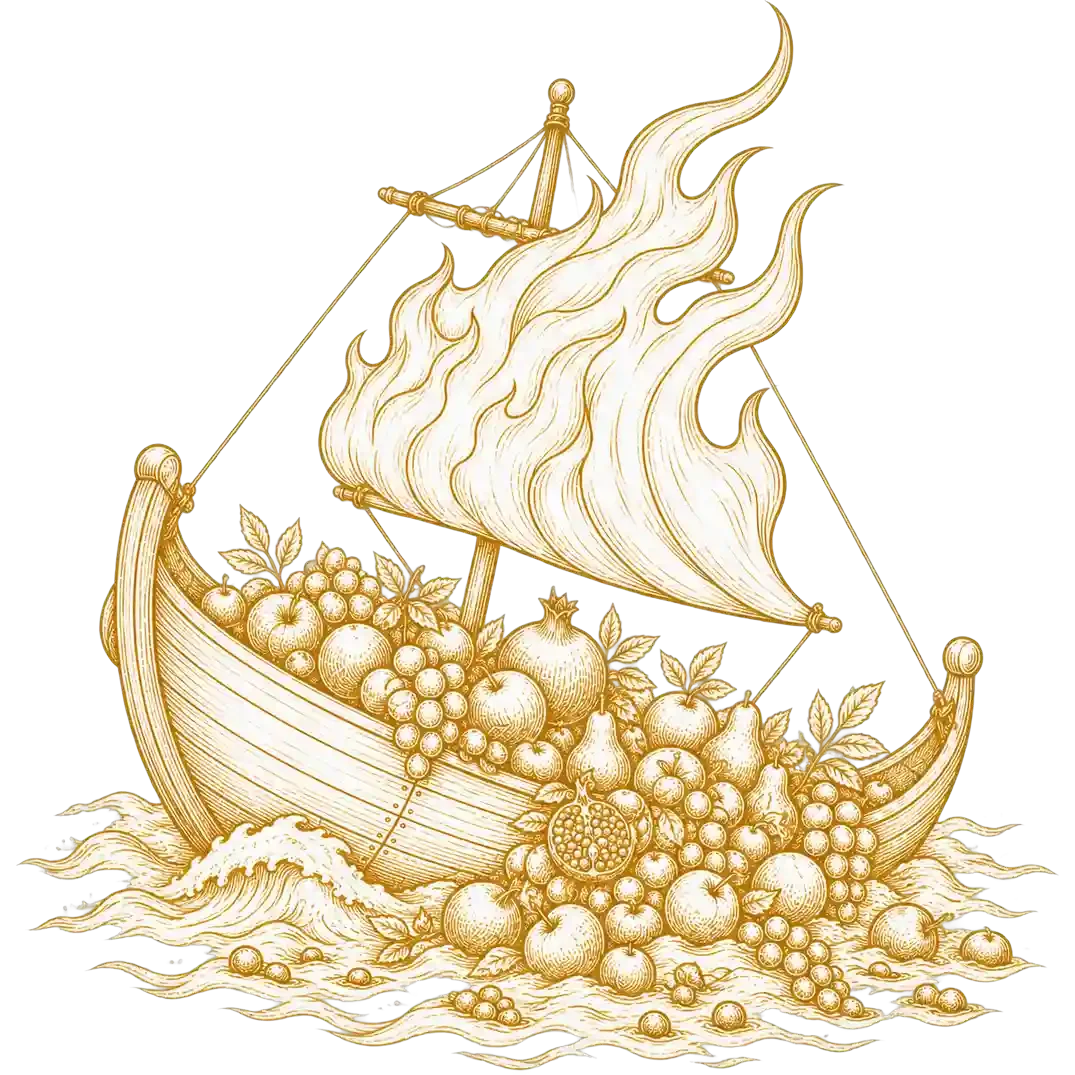
Story: Polycarp’s Harbor
What or who is Polycarp? Polycarp is the name of a second-century bishop of the Catholic Church in Smyrna, a saint. He was a man of great faith and fervent love who brought many souls to Christ Jesus in the midst of fierce persecution. He was so zealous and passionate that he was known throughout the region for snatching people from the worship of their false gods and bringing them into the Church. He likely had a single-handedly-devastating impact on the economy due to that fact, with idol worship being a major source of revenue for most major cities of the time.
Due to our monotheistic beliefs, the early Christians were persecuted as “atheists” because they denied the many false gods worshipped by the rest of the world. As such, when they desired a blow be dealt to the Christians, knowing the reverence in which Polycarp was held by all, they demanded, “Away with the atheists; let Polycarp be sought out!” Three days before he was taken, he had a vision of his pillow set ablaze and told those with him, “I must be burned alive.”
When those sent to arrest him arrived, he ordered food and drink be brought for them and asked only that he be allowed to pray for an hour. He prayed for two. And so lovely was he, caught up in the love of God as he prayed, that many of those seeking to arrest him repented for having come after him at all.
In the now classic fashion of a saint, though it might be said that he helped put it into fashion, this was his response on being told to renounce Christ:
“Swear by the fortune of Cæsar; repent, and say, Away with the Atheists.” But Polycarp, gazing with a stern countenance on all the multitude of the wicked heathen then in the stadium, and waving his hand towards them, while with groans he looked up to heaven, said, “Away with the Atheists.” Then, the proconsul urging him, and saying, “Swear, and I will set you at liberty, reproach Christ;” Polycarp declared, Eighty and six years have I served Him, and He never did me any injury: how then can I blaspheme my King and my Saviour?”
His response is one that rightly mocks the littleness of men and exalts the love of God. When told he would be burned for his faith, he said,
“You threaten me with fire which burns for an hour, and after a little is extinguished, but are ignorant of the fire of the coming judgment and of eternal punishment, reserved for the ungodly. But why do you tarry? Bring forth what you will.”
When they tried to bind him, so as to keep him from fleeing the flames, he responded plainly,
“Leave me as I am; for He that gives me strength to endure the fire, will also enable me, without your securing me by nails, to remain without moving in the pile.”
In the account of his martyrdom, it is said they beheld a great miracle. The flame would not touch him and formed itself into something like the sail of a ship. As they beheld his appearance, he became not like flesh burned but bread baked, and a sweet aroma emanated from the pile like that of fine spices. When it was clear the fire would do him no harm, he was stabbed in the heart with a dagger, from which a dove flew out and enough blood poured so as to quench the fire.
Polycarp burned with a zeal so fiery that temporal flames could not touch him and the flames of Hell would be too cool. He was so conformed to Christ that his bloodshed quenched the flames of his judgement. He was so in love with the Lord Jesus that he freely gave himself up to His will, seeking out the death God had called him to die. And what happened? A bountiful harvest.
It is a truth that the blood of the martyrs is the seed of the Church. It is of little doubt that the persecution of the Church in Smyrna, especially that of St. Polycarp, is in view when the Apostle John (whom St. Polycarp knew personally) writes to the Church in Smyrna in the book of Revelation. Christ Himself says to that Church, “Be faithful unto death, and I will give you the crown of life. He who has an ear, let him hear what the Spirit says to the churches. The one who conquers will not be hurt by the second death.”
The name Polycarp literally means “much fruit.” The fulness of that name is revealed throughout his life and most strikingly in the death of his body, when he entered heavenly glory to be with the one whom his soul loved. To this day, men and women are brought to the Catholic Church through his faith and intercession. I myself am one of those and St. Polycarp is my patron, glory to Jesus Christ.
I am sure by now you can see the logic behind the name of this place and the icon that heads it. The ship with a burning sail, overflowing with fruit captures that picture of the life and love of St. Polycarp and, I hope, inspires you to the same. Why a ship? Because we are all on a journey. Why a harbor? Because we all need rest and trade along the way.
The leading icon of this place also summarizes the design philosophy of Polycarp’s Harbor. All that we create will be excellent, beautiful, thought-provoking, and, I pray, a channel of grace. May God bless you.
The Final Prayer of Saint Polycarp, Bishop of Smyrna
O Lord God Almighty, the Father of your beloved and blessed Son Jesus Christ, by whom we have received the knowledge of You, the God of angels and powers, and of every creature, and of the whole race of the righteous who live before you, I give You thanks that You have counted me, worthy of this day and this hour, that I should have a part in the number of Your martyrs, in the cup of your Christ, to the resurrection of eternal life, both of soul and body, through the incorruption imparted by the Holy Ghost. Among whom may I be accepted this day before You as a fat and acceptable sacrifice, according as You, the ever-truthful God, have foreordained, have revealed beforehand to me, and now have fulfilled. Wherefore also I praise You for all things, I bless You, I glorify You, along with the everlasting and heavenly Jesus Christ, Your beloved Son, with whom, to You, and the Holy Ghost, be glory both now and to all coming ages. Amen.
In Caritate Christi Requiesce
